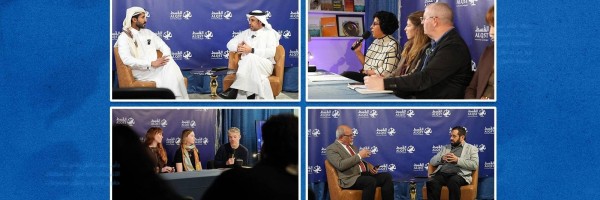
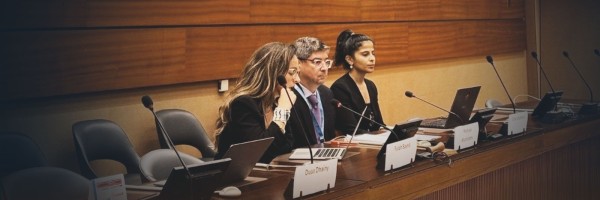
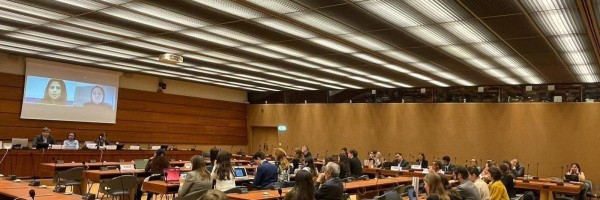
On 29 March 2021, ALQST's Head of Monitoring and Communications Lina AlHathloul spoke in an online UN Human Rights Council 49th Session (HRC49) side event about the challenges faced by women human rights defenders online. The event, organised by the United States and European Union Trade and Technology Council (U.S.-EU TTC) Partnership, in partnership with Access Now, can be viewed here, and you can read Lina AlHathloul’s remarks below.
Good afternoon everyone. My name is Lina Alhathloul, I am a Saudi activist & Head of Monitoring and Communications at ALQST.
In Saudi Arabia, freedom of assembly and of speech, among other freedoms, are forbidden. So for HRDs, the online sphere is a tool where they can continue to raise injustices, and fight for more rights while protecting their identities.
However, in recent years this same tool has become an unsafe space, which is used to harass, intimidate and sometimes even arrest HRDs, creating fear and isolation in the virtual world as well.
What we should emphasize today is that cyberhate follows the same patterns as attacks in public spaces, and the attacks on women aren’t different from the “real world”. It is often sexual harassment, threats of violence and rape, and also questions around the legitimacy of a human rights’s defender’s public discourse because of her gender.
As WHRD in the region, we are harassed in many different ways. I’ll quickly give you examples:
My own sister, Loujain Alhathloul who was one of the leaders of the Women2Drive campaign, has been targeted with Pegasus, before and after her imprisonment.
During her imprisonment, and while she was forcibly disappeared, trolls online would tell me that she would give a sign once they’ve managed to abort her because she had been raped in her cell (which turned out to be lies to intimidate me and silence me).
Moreover, as a human rights defender myself, I am worried I'll be spied on online, fearing for the safety of the people who contact me mostly.
In fact, in Saudi Arabia, some twitter users have been arrested solely for tweeting online. A group of young activists have been forcibly disappeared since May 2021. Others have been summoned and pledged to end their activism online in exchange for their freedom.
The online space is not safe, and it gets worse when a country criminalizes cyber security. In fact, HRDs have been officially charged with attending cyber security conferences. The government is thus explicitly admitting its ambitions to prevent individuals to acquire the skills to move more safely online and deprive people of the knowledge to better protect themselves online.
There is a lot to be done for us, WHRD to feel safe online, and I am looking forward to the discussion and questions.
Thank you